





 Garantía de entrega




SKU/Artículo: AMZ-B0GPNF2T64
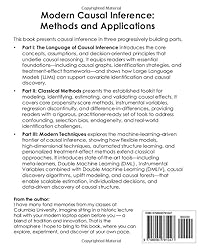
Modern Causal Inference: Methods and Applications: An Essential Hands-on Guide with DoWhy, EconML, CausalML, Causal-learn in Python
Format:
Paperback
Detalles del producto
Disponibilidad:
En stock
En stock
Peso con empaque:
0.81 kg
0.81 kg
Devolución:
Sí
Sí
Condición
Nuevo
Nuevo
Producto de:
Amazon
Amazon
Viaja desde
USA
USA
Sobre este producto
- Buy the Paperback – Get the Complimentary Digital Edition Free Purchase the paperback edition and enjoy a complimentary digital edition on your favorite device—yours to keep for personal use. The print edition adopts the classic Springer font and layout for pleasing reading. The digital edition adopts a beautiful Latex layout for pleasing reading. Causal inference has emerged as one of the most exciting and rapidly evolving areas in data science. Interest and applications are growing across fields — from economics and healthcare to marketing and social sciences. Alongside this, new programming tools and techniques have made it easier than ever to implement advanced causal methods in practice. All of these innovations are brought together in Modern Causal Inference: Methods and Applications. This book offers a practical, hands-on guide for students, researchers, and practitioners eager to unlock the power of cause-and-effect reasoning in the age of data.This book presents causal inference in three progressively building parts.Part I: The Language of Causal Inference introduces the core concepts, assumptions, and decision-oriented principles that underlie causal reasoning. It equips readers with essential foundations—including causal graphs, identification strategies, and treatment-effect frameworks—and shows how Large Language Models (LLMs) can support covariate identification and causal discovery.Part II: Classical Methods presents the established toolkit for modeling, identifying, estimating, and validating causal effects. It covers core propensity-score methods, instrumental variables, regression discontinuity, and difference-in-differences, providing readers with a rigorous, practitioner-ready set of tools to address confounding, selection bias, endogeneity, and real-world identification challenges.Part III: Modern Techniques explores the machine-learning–driven frontier of causal inference, showing how flexible models, high-dimensional techniques, automated structure learning, and personalized treatment-effect methods extend classical approaches. It introduces state-of-the-art tools—including meta-learners, Double Machine Learning (DML), Instrumental Variables combined with Double Machine Learning (DMLIV), causal discovery algorithms, uplift modeling, and causal forests—that enable scalable estimation, individualized decisions, and data-driven discovery of causal structure.Who This Book Is For This book is designed for readers who already have some experience in statistics, regression, and data science, and who want to deepen their understanding of causal inference. It is ideal for:Instructors and students: Perfect for courses in causal inference, this book balances theory with hands-on applications. It helps students understand not just how methods work, but why they matter. Structured chapters, practical examples, and Python code make it easy to integrate into a semester-long curriculum or self-paced study.Professionals and data practitioners: For data scientists, analysts, or researchers looking to apply causal inference to real-world problems, this book offers step-by-step guidance, case studies, and modern Python tools to bridge the gap between theory and practice.Software in This Book The Python notebooks for this book are available in the book’s GitHub repository: https://github.com/dataman-git/causal_inferenceFrom the AuthorI have many fond memories from my classes at Columbia University. Imagine sitting in a historic lecture hall, sunlight streaming through tall windows, with your modern laptop open before you — a blend of tradition and innovation. That is the atmosphere I hope to bring to this book. Chris Kuo, New York City
S/ 467.08
49% OFF
S/ 239.53
IMPORT EASILY
By purchasing this product you can deduct VAT with your RUT number
S/ 467.08
49% OFF
S/ 239.53
 Llega en 5 a 10 días hábiles
con envío
 Tienes garantía de entrega
Compra protegida
Disfruta de una experiencia de compra segura y confiable
![]() Garantía de entrega
Garantía de entrega
Con Tiendamia todas tus compras cuentan con Garantía de Entrega o devolución total de tu dinero.
Compras 100% seguras y garantizadas, para que pidas lo que sueñas y lo recibas del mundo a tu puerta.
Saber más.
Visa

Mastercard

American Express