










SKU/Artículo: AMZ-B0FSY557PQ
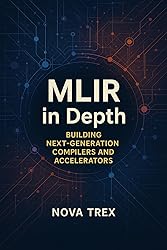
MLIR in Depth: Building Next-Generation Compilers and Accelerators
Format:
Kindle
Detalles del producto
Disponibilidad:
Fuera de stock
Fuera de stock
Peso con empaque:
0.15 kg
0.15 kg
Devolución:
Sí
Sí
Condición
Nuevo
Nuevo
Producto de:
Amazon
Amazon
Viaja desde
USA
USA
Sobre este producto
- Modern workloads demand compilers that are both domain-aware and long-lived, and MLIR meets that need by organizing intermediate representation as a stack of interoperable dialects with precise invariants. This book offers a comprehensive, practitioner-focused exploration of MLIR’s architecture—its operation-centric model with regions and SSA, dialect isolation and composition, control-flow semantics, memory and side-effect modeling, and the concurrency-safe runtime that makes large-scale IR manipulation practical. From first principles to design rationale, it shows how multi-level IR unlocks analyzability, reuse, and dependable optimization across heterogeneous targets. You will learn to define robust dialects and operations using ODS/TableGen, craft custom types and attributes with uniqued storage, and encode semantics through traits, interfaces, verifiers, folders, and canonicalization. The text covers IR construction in C++ and Python, symbol tables and visibility, round-trip-stable parsing and printing, and the contracts needed for safe inter-dialect composition. It then builds mastery in pass infrastructure and pattern rewriting—greedy drivers, benefit modeling, PDL/PDLL, analysis preservation, and instrumentation—before developing full dataflow analyses, dependence and alias reasoning, interprocedural summaries, and shape/range inference. A rich treatment of lowering and conversion follows, including dynamic legality, type conversion, tensor-to-memref bufferization, structured-to-CFG control flow, async models, and correctness boundaries that guard against undefined behavior. Performance and production-readiness are front and center. The book details loop tiling, fusion, vectorization with the Vector dialect, affine/polyhedral scheduling, sparse tensor compilation, layout and cache optimization, and the Transform dialect for parametric flows and autotuning with profile- and cost-guided decisions. It walks through target integration and code generation to LLVM, NVVM, ROCDL, and SPIR-V, GPU kernels and synchronization, ABI design, debug info, and object emission. For accelerators, it shows how to design custom dialects, build quantization pipelines, schedule compute and DMA, and map with hardware-informed cost models, while interoperating with XLA, OpenXLA, TVM, and IREE runtimes such as CUDA, ROCm, and IREE HAL. Tooling chapters cover pipeline authoring, tblgen integration, FileCheck/lit testing, visualization, Python bindings and JIT, diagnostics, security hardening, and versioning, culminating in end-to-end case studies that translate methodology into reliable, high-performance systems. This is the definitive guide for compiler engineers, ML systems builders, and hardware teams who need to turn sophisticated ideas into production-grade software.

Producto prohibido
Este producto no está disponible
Este producto viaja
de USA ![]() a tus manos en
a tus manos en
![]()
 a tus manos en

Compra protegida
Disfruta de una experiencia de compra segura y confiable
Tarjetas de Crédito y Débito

Visa

Mastercard

American Express
Pagos a través de PayPal
Compra procesada en dólares con dinero en cuenta o tarjetas internacionales.

Paypal
Pagos a través de MODO
Compra procesada en pesos desde la App de tu banco.

PayPal

 Tienes garantía de entrega