







SKU/Artículo: AMZ-B0F8ZV7SKD
Deep Learning for Network Engineers: Understanding Traffic Patterns and Network Requirements in the AI Data Center
Format:
Paperback
Detalles del producto
Disponibilidad:
En stock
En stock
Peso con empaque:
0.54 kg
0.54 kg
Devolución:
Sí
Sí
Condición
Nuevo
Nuevo
Producto de:
Amazon
Amazon
Viaja desde
USA
USA
Sobre este producto
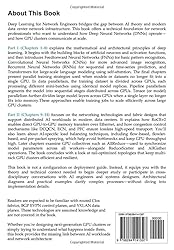
- About the Book Deep Learning for Network Engineers bridges the gap between AI theory and modern data center network infrastructure. This book offers a technical foundation for network professionals who want to understand how Deep Neural Networks (DNNs) operate—and how GPU clusters communicate at scale. Part I (Chapters 1–8) explains the mathematical and architectural principles of deep learning. It begins with the building blocks of artificial neurons and activation functions, and then introduces Feedforward Neural Networks (FNNs) for basic pattern recognition, Convolutional Neural Networks (CNNs) for more advanced image recognition, Recurrent Neural Networks (RNNs) for sequential and time-series prediction, and Transformers for large-scale language modeling using self-attention. The final chapters present parallel training strategies used when models or datasets no longer fit into a single GPU. In data parallelism, the training dataset is divided across GPUs, each processing different mini-batches using identical model replicas. Pipeline parallelism segments the model into sequential stages distributed across GPUs. Tensor (or model) parallelism further divides large model layers across GPUs when a single layer no longer fits into memory.These approaches enable training jobs to scale efficiently across large GPU clusters. Part II (Chapters 9–14) focuses on the networking technologies and fabric designs that support distributed AI workloads in modern data centers. It explains how RoCEv2 enables direct GPU-to-GPU memory transfers over Ethernet, and how congestion control mechanisms like DCQCN, ECN, and PFC ensure lossless high-speed transport. You’ll also learn about AI-specific load balancing techniques, including flow-based, flowlet-based, and per-packet spraying, which help avoid bottlenecks and keep GPU throughput high. Later chapters examine GPU collectives such as AllReduce—used to synchronize model parameters across all workers—alongside ReduceScatter and AllGather operations. The book concludes with a look at rail-optimized topologies that keep multi-rack GPU clusters efficient and resilient. This book is not a configuration or deployment guide. Instead, it equips you with the theory and technical context needed to begin deeper study or participate in cross-disciplinary conversations with AI engineers and systems designers. Architectural diagrams and practical examples clarify complex processes—without diving into implementation details. Readers are expected to be familiar with routed Clos fabrics, BGP EVPN control planes, and VXLAN data planes. These technologies are assumed knowledge and are not covered in the book. Whether you're designing next-generation GPU clusters or simply trying to understand what happens inside them, this book provides the missing link between AI workloads and network architecture. This book provides a theoretical and conceptual overview. It is not a configuration or implementation guide, although some configuration examples are included to support key concepts. Since the focus is on the Deep Learning process, not on interacting with or managing the model, there are no chapters covering frontend or management networks. The storage network is also outside the scope. The focus is strictly on the backend network. The goal is to help readers—especially network professionals—grasp the “big picture” of how Deep Learning impacts data center networking.
AR$97.642
55% OFF
AR$44.382
IMPORT EASILY
By purchasing this product you can deduct VAT with your RUT number
AR$97.642
55% OFF
AR$44.382
 Llega en 8 a 12 días hábiles
con envío
 Tienes garantía de entrega
Este producto viaja
de USA ![]() a tus manos en
a tus manos en
![]()
 a tus manos en

Compra protegida
Disfruta de una experiencia de compra segura y confiable
Tarjetas de Crédito y Débito

Visa

Mastercard

American Express
Pagos a través de PayPal
Compra procesada en dólares con dinero en cuenta o tarjetas internacionales.

Paypal
Pagos a través de MODO
Compra procesada en pesos desde la App de tu banco.

PayPal