









SKU/Artículo: AMZ-B0DXFGWXMQ
hiBCTR
hiBCTR 2 - Piece Set: Mini Controller Board Modules for Nano V3.0 ATmega328P Compatible with Arduino, Comes with USB Cable + Expansion I/O Shield Breakout Screw Terminal Adapter for Nano V3.0
Detalles del producto
Disponibilidad:
En stock
En stock
Peso con empaque:
0.15 kg
0.15 kg
Devolución:
Sí
Sí
Condición
Nuevo
Nuevo
Producto de:
Amazon
Amazon
Viaja desde
USA
USA
Sobre este producto
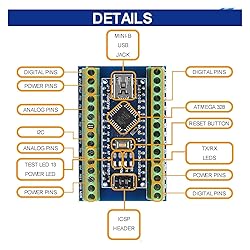
- Specifications Operating Voltage (Logic Level): 5V Analog Input Ports: 8 ports from A0 to A7 Digital Input/Output Ports: 14 ports including TX, RX, D2 - D13 PWM Ports: 6 ports (D3, D5, D6, D9, D10, D11) Serial Transceiver Ports: 1 pair of TTL - level RX/TX ports MCU: Equipped with Atmel Atmega328P - AU MCU Bootloader: Pre - installed bootloader Power Options: Supports USB download and power supply, external 5V - 12V DC power, and 9V battery power Instructions Download the (for Arduino) IDE with ATmega 328P (old bootloader). Download the USB chip driver. Plug in the Nano development board, and the driver will install automatically. Select the Nano board in the IDE. Select the COM port, which can be checked in "My Computer". It's recommended to choose the Nano's default example program and upload it.

Producto prohibido
Este producto no está disponible
Este producto viaja
de USA ![]() a tus manos en
a tus manos en
![]()
 a tus manos en

Conoce más detalles
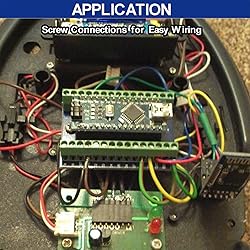
Product Overview: Nano is a compact, all - in - one breadboard - friendly board based on ATmega328P (for Arduino for Nano 3.x). It's functionally similar to Arduino Duemilanove but in a different package. Power Supply: Nano can be powered via Mini - B USB, a 6 - 20V unregulated external power source (pin 30), or a 5V regulated external power source (pin 27). The highest - voltage power source is automatically selected. Pin Features: The improved version for Nano V3.0 ATMEGA328P has 3 headers (2 15 - pin connectors + 1 6 - pin connector). Its 14 digital pins can serve as inputs or outputs, operating at 5V, with a max current of 40 mA per pin and an internal pull - up resistor (default off) of 20 - 50 kOhms. Analog pins 6 and 7 can't be used as digital pins, and some pins have special functions. Communication Facilities: Nano offers multiple communication options, including UART TTL (5V) serial communication, I2C (TWI), and SPI for communication with computers, other Arduinos, or microcontrollers. Additional Component & Note: An extra expansion board brings I/O outputs to screw terminals, ideal for projects with numerous wires. Note to first download the (for Arduino) IDE with ATmega 328P (old bootloader) and the USB chip driver.
Compra protegida
Disfruta de una experiencia de compra segura y confiable
Tarjetas de Crédito y Débito

Visa

Mastercard

American Express
Pagos a través de PayPal
Compra procesada en dólares con dinero en cuenta o tarjetas internacionales.

Paypal
Pagos a través de MODO
Compra procesada en pesos desde la App de tu banco.

PayPal

 Tienes garantía de entrega