







SKU/Artículo: AMZ-B0DSG6DHZT
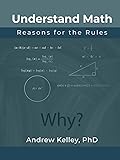
Understand Math: Reasons for the Rules
Format:
Hardcover
Detalles del producto
Disponibilidad:
En stock
En stock
Peso con empaque:
1.20 kg
1.20 kg
Devolución:
Sí
Sí
Condición
Nuevo
Nuevo
Producto de:
Amazon
Amazon
Viaja desde
USA
USA
Sobre este producto
- Does math seem like a bunch of arbitrary rules? This book is here to explain clearly why most of the rules aren't arbitrary at all. There are good reasons for them! The purpose of this book is to explain the reasons for the main rules learned in middle school and high school mathematics (i.e., for 6th through 12th grade). It is written from a conservative, Christian perspective. For most rules, instead of giving rigorous proofs, Dr. Kelley focuses on the essence for why they work. For a free sample and reviews from homeschool moms and math teachers see UnderstandMathRules.com Cathy Duffy wrote that Dr. Kelley's "process is the same as that used by excellent teachers interacting with students to help them develop understanding." Why learn the reasons for the rules?If you understand why a rule works and know why it is true, then you are more likely to remember the rule, use it correctly, and know when it applies and when it doesn't. Having real insight can also set you apart. Also, when math makes sense, it is much more enjoyable.A supplement to traditional curriculumThis book isn't meant to be a standard textbook used for just one year of school. Rather, Dr. Kelley tried to make it the best supplement to use while studying math in middle school and high school. Homeschoolers and those teaching themselves should find this book incredibly helpful.Contents:Chapter 1: FractionsThis chapter explains why fractions add, multiply, divide, and reduce the way they do.Chapter 2: Pre-algebraThis chapter explains variables, equations, exponents, distributing, factoring, and graphs of lines.Chapter 3: ArithmeticHow does the decimal system work? Why does multiplication of multi-digit numbers work the way it does? Why can't we divide by 0? How do computers represent whole numbers? This chapter answers these questions and more.Chapter 4: AlgebraThis chapter explains square roots, functions, variables inside fractions, logarithms, inequalities, completing the square, and more.Chapter 5: GeometryWhy is the area of a circle pi times the radius squared? Why is the Pythagorean theorem true? This chapter explains why. This is the shortest chapter in the book because high school level geometry courses usually include proofs for most of the results.Chapter 6: LogicThis chapter explains both mathematical and non-mathematical fallacies. It also explains how the usage of logical terms in English differs from their use in mathematics. Why are there infinitely many prime numbers? Why is the square root of 2 irrational? This chapter says why.Chapter 7: TrigonometryWhy are the trigonometric identities true? How can we get an intuitive grasp of the trig functions? This chapter shows how.Chapter 8: Complex numbers: i = square root of -1This chapter explains why "imaginary" numbers should not be considered mysterious, weird, or useless.Chapter 9: ProbabilityWhat is most important in a first course on probability? This chapter was written to answer that question.Chapter 10: PrecalculusThis chapter explains functions thoroughly. It also gives a graphical reason why square roots do not distribute. Advanced factoring methods are also included.Chapter 11: CalculusThis chapter gives intuitive explanations of the most important concepts in calculus. What is the essence of the Fundamental Theorem of Calculus? How can the derivative rules be understood intuitively? How can you add up infinitely many positive numbers and not get infinity? This chapter says how.Chapter 12: What is mathematics?What else is there to math beyond traditional curriculum? This bonus chapter is for readers who want to know what is not normally taught in high school. A little bit of the history math is also included.
AR$127.564
31% OFF
AR$87.975
IMPORT EASILY
By purchasing this product you can deduct VAT with your RUT number
AR$127.564
31% OFF
AR$87.975
 Llega en 8 a 12 días hábiles
con envío
 Tienes garantía de entrega
Este producto viaja
de USA ![]() a tus manos en
a tus manos en
![]()
 a tus manos en

Compra protegida
Disfruta de una experiencia de compra segura y confiable
Tarjetas de Crédito y Débito

Visa

Mastercard

American Express
Pagos a través de PayPal
Compra procesada en dólares con dinero en cuenta o tarjetas internacionales.

Paypal
Pagos a través de MODO
Compra procesada en pesos desde la App de tu banco.

PayPal