







 Garantía de entrega

Artículo: AMZ-B0GCT3T9G7
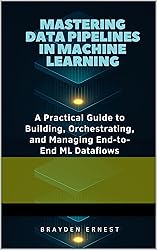
Mastering Data Pipelines in Machine Learning: A Practical Guide to Building, Orchestrating, and Managing End-to-End ML Dataflows
Format:
Kindle
Detalles del producto
Disponibilidad
Sin stock
Sin stock
Peso con empaque
0.84 kg
0.84 kg
Devolución
No
No
Condición
Nuevo
Nuevo
Producto de
Amazon
Amazon
Viaja desde
USA
USA
Sobre este producto
- Mastering Data Pipelines in Machine Learning is a practical, hands-on guide to building ML data systems that ship on time, scale smoothly, and are easy to operate. You’ll learn how to design clear data flows, enforce contracts, automate training and deployment, and keep costs in check—using code you can copy, adapt, and run in production. This book distills patterns proven across real-world ML platforms—feature backbones on Delta/Iceberg, streaming freshness lanes on Kafka/Spark/Flink, feature caching with Redis, CI/CD with Helm and GitHub Actions, and monitoring with Prometheus, Grafana, and OpenTelemetry. Every chapter includes complete, working examples, promotion gates that actually block bad releases, and runbooks you can rely on at 2 a.m. About the Technology Modern ML products demand more than clever models—they need dependable pipelines. Open table formats (Delta/Iceberg) bring ACID and time travel to your lake. Engines like Spark, Flink, Dask, and Trino handle scale. Orchestrators (Airflow/Prefect/Dagster) coordinate work. MLflow provides model governance. Observability stacks (Prometheus + Grafana + OTel) turn unknowns into actionable signals. This book shows how to fit these pieces together without overengineering. What’s InsideArchitecture patterns: Two-lane design (batch backbone + small freshness stream) with strong data contracts.Ingestion & transformation: Schema enforcement, idempotent writes, scalable ETL, and reproducible feature stores.Training & evaluation: MLflow tracking, data manifests, automated promotion gates, and canary strategies.Serving: Read-through feature caching, bounded concurrency, latency SLOs, and safe fallbacks.Observability: Metrics that matter (freshness, p95, error rate, bytes scanned), drift monitoring, and tracing.Cost & scale: File layout hygiene, partition pruning, compaction, and spot-friendly orchestration.Security & reliability: CI/CD pipelines with scanning, versioned releases, and rollback playbooks.Appendices: Deployment blueprints, checklists, and a concise tool reference. Who This Book Is ForML engineers productionizing models and features.Data engineers building reliable, cost-aware pipelines.MLOps/platform teams standardizing workflows and SLOs.Tech leads/architects defining patterns and guardrails for cross-team ML delivery. Most ML failures aren’t model failures—they’re pipeline failures: stale partitions, schema drift, noisy alerts, and costly overreads. Every release you ship without contracts and gates risks silent regressions and rising bills. Fixing the foundation now pays off immediately in stability and speed. You’ll get value quickly: Chapter 1 sets up executable data contracts; by Chapter 3 you’re transforming data at scale; by Chapter 5 you’re orchestrating resilient DAGs; Chapters 8–10 turn observability and CI/CD into a predictable release motion. You can implement the core patterns in weeks, not quarters. Replacing ad-hoc scripts with a clean architecture reduces failures, shortens incident time, and cuts compute costs—often by 30–60% through better pruning, compaction, and caching. The included templates (Helm, CI/CD, PromQL rules, MLflow gates) save months of trial and error and become shared standards across teams. Ship ML like a pro. Start reading today, wire the first data contract, and turn your pipeline into a product your team—and your customers—can trust.

Sin stock
Seleccione otra opción o busque otro producto.
Este producto viaja
de USA ![]() a tus manos en
a tus manos en
![]()
 a tus manos en

Compra protegida
Disfruta de una experiencia de compra segura y confiable
![]() Garantía de entrega
Garantía de entrega
Con Tiendamia todas tus compras cuentan con Garantía de Entrega o devolución total de tu dinero.
Compras 100% seguras y garantizadas, para que pidas lo que sueñas y lo recibas del mundo a tu puerta.
Tarjetas de Débito y Crédito

Visa

Mastercard

American Express

Dinners

Discover

Alias
Pagos a través de PayPal
Compra procesada en dólares con dinero en cuenta o tarjetas internacionales.

PayPal

.svg)
 Garantía de entrega