



 Garantía de entrega




Artículo: AMZ-3961101876
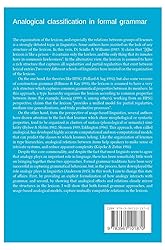
Analogical classification in formal grammar
Format:
Hardcover
Detalles del producto
Disponibilidad
En stock
En stock
Peso con empaque
0.68 kg
0.68 kg
Devolución
Sí
Sí
Condición
Nuevo
Nuevo
Producto de
Amazon
Amazon
Viaja desde
USA
USA
Sobre este producto
- The organization of the lexicon, and especially the relations between groups of lexemes is a strongly debated topic in linguistics. Some authors have insisted on the lack of any structure of the lexicon. In this vein, Di Sciullo & Williams (1987: 3) claim that "[t]he lexicon is like a prison - it contains only the lawless, and the only thing that its inmates have in commonis lawlessness". In the alternative view, the lexicon is assumed to have a rich structure that captures all regularities and partial regularities that exist between lexical entries.Two very different schools of linguistics have insisted on the organization of the lexicon. On the one hand, for theories like HPSG (Pollard & Sag 1994), but also some versions of construction grammar (Fillmore & Kay 1995), the lexicon is assumed to have a very rich structure which captures common grammatical properties between its members. In this approach, a type hierarchy organizes the lexicon according to common properties between items. For example, Koenig (1999: 4, among others), working from an HPSG perspective, claims that the lexicon "provides a unified model for partial regularties, medium-size generalizations, and truly productive processes". On the other hand, from the perspective of usage-based linguistics, several authors have drawn attention to the fact that lexemes which share morphological or syntactic properties, tend to be organized in clusters of surface (phonological or semantic) similarity (Bybee & Slobin 1982; Skousen 1989; Eddington 1996). This approach, often called analogical, has developed highly accurate computational and non-computational models that can predict the classes to which lexemes belong. Like the organization of lexemes in type hierarchies, analogical relations between items help speakers to make sense of intricate systems, and reduce apparent complexity (Köpcke & Zubin 1984). Despite this core commonality, and despite the fact that most linguists seem to agree that analogy plays a
$124,68
49% OFF
$63,94
IMPORT EASILY
By purchasing this product you can deduct VAT with your RUT number
$124,68
49% OFF
$63,94
Envío gratis
 Llega en 12 a 16 días hábiles
Con envío
 Tienes garantia de entrega
Este producto viaja
de USA ![]() a tus manos en
a tus manos en
![]()
 a tus manos en

Compra protegida
Disfruta de una experiencia de compra segura y confiable
![]() Garantía de entrega
Garantía de entrega
Con Tiendamia todas tus compras cuentan con Garantía de Entrega o devolución total de tu dinero.
Compras 100% seguras y garantizadas, para que pidas lo que sueñas y lo recibas del mundo a tu puerta.
Tarjetas de Débito y Crédito

Visa

Mastercard

American Express

Dinners

Discover

Alias
Pagos a través de PayPal
Compra procesada en dólares con dinero en cuenta o tarjetas internacionales.

PayPal

.svg)